


CAPTION: General Synod took place in London from the 9-13 February 2026.
Reflections on February General Synod
General Synod took place in London last week from the 9 to the 13 February.
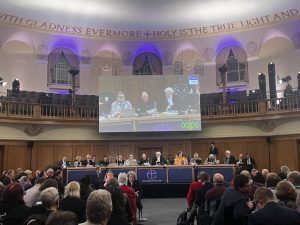 The General Synod is the national assembly of the Church of England, and it considers and approves legislation affecting the whole of the Church of England, formulates new forms of worship, debates matters of national and international importance, and approves the annual budget for the work of the Church at national level.
Items discussed at February’s General Synod included the conclusion of the Living in Love and Faith process, Safeguarding, Mental Health and the Church, Poverty and the church, Parochial Fees and more.
The Diocese of Exeter has 5 clergy and 4 lay General Synod representatives, plus the Bishop of Exeter, who attended the five-day synod and took part in debates and votes.
Last week Bishop Mike made his maiden speech to General Synod, proposing a motion for a new House of Bishop’s code of practice on Mission Iniatives (known as Bishop’s Mission Orders). He was speaking in his capacity as the Church of England’s lead bishop on Planting and Fresh Expressions of Church.
In his speech Bishop Mike said, “We need to be in the business of enabling rather than hindering mission iniatives.”
Bishop Mike outlined that a working group had been set up in the wake of the Scolding Review into safeguarding failures relating to Mike Pilavachi and Soul Survivor church. A number of the recommendations made by Scolding related to the operation of BMOs. Bishop Mike said that the working group, of which he was a part, considered how the BMO code of conduct might be amended to implement the recommendations.
He said the new code of conduct was designed to be a useful tool, not only to mission initiaitves operating under a BMO but also smaller expressions of church, for example new worshipping communities – like Messy Church or Forest Church. He commended the code as a key part of making the Church a safer place for all.
Reflecting on his debut speech, Bishop Mike said, “It was good to highlight the work of Pioneers, Fresh Expressions and New Worshipping Communities and also advert to new resources such as a template for BMOs. The Code will also be best practice guide for New Worshipping Communities.”
The Archdeacon of Totnes and Simon Friend, who are both Exeter General Synod representatives also spoke during the debate on the motion, which was passed by General Synod.
 The Rev’d Prebendary Rosie Austen, Team Rector of the Shirwell Mission Community, was one of our diocesan representatives at Synod.
Rosie said, “It was a long week and long days, but when we come together in worship and discussion seeking ways forward as one body, God is with us.”
A highlight for Rosie included the personal stories shared in the mental health, poverty and working class debates, which were ‘challenging and moving’, and also a fringe meeting with conversations about the funding of rural churches.
Another highlight for Rosie was the friendships built at General Synod.She said, “One of the highlights are the friendships that have grown over five years of Synod, and new friends being made each time we meet. Friendships across difference are particularly valuable.”
The Archbishop of Canterbury’s Address
Another poignant moment for Rosie included the warm welcome and ovation for the Archbishop of Canterbury, the Most Reverend and Right Honourable Dame Sarah Mullally DBE, and the wisdom of her opening address.
This Synod marked Archbishop Sarah Mullally becoming the first woman to give a presidential address Church of England’s General Synod.
During her speech she said “When the wind and the waves are rocking the boat, I am reminded that what I need to do is to focus on Christ, who calms the waters and stills the wind. With your help and with God’s grace, I pray that I am able to approach this ministry with calm, consistency and compassion – as we seek to be what the Church has for so long been: a stable presence in an unstable world.”
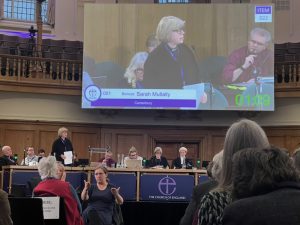 “At my Confirmation of Election, I was deeply moved to be asked, during the Charge which was given to me, to ‘help the Church love itself more … believing that its best days are still to come’. And I do believe that this is true. Through every challenge, our hope in Christ remains – and our confidence in the Gospel, as good news for our nation and for God’s world, is not shaken.”
Archbishop Sarah also spoke about safeguarding in the Church of England, something she has already received criticisim for in relation to her handling of some previous safeguarding cases.
She said, “Safeguarding is a fundamental, non-negotiable responsibility, sharpened by our past failings and shaped by the work we still have to do. I am committed to bringing an approach of seriousness and focussed direction to all matters relating to safeguarding in all contexts in the church. This approach must be trauma-informed, put victims and survivors at the heart of all we do and be committed to proper independence.
Elections will open later this year
Elections for clergy and lay representatives for the next five year term of the General Synod will take place this summer. Five clergy and lay representatives will be elected from the Diocese of Exeter.
The election period is expected to start on the 14 July 2026, straight after the end of the next and final meeting of the General Synod in the current quinquennium.
More information will be made available in the period leading up to the elections and will be shared on our website and our Roots & Shoots newsletter.
The Archdeacon of Totnes, the Venerable Douglas Dettmer, said of General Synod, “Apart from Parliament, the General Synod is the only elected body which is able to make the law of the land for England. Apart from its core role in ecclesiastical legislation, the Synod is entitled to consider and express its opinion on any matters of religious or public interest, and every group of sessions has significant issues of public policy on its agenda as well as current questions in the Church of England’s common life.
“Members of the General Synod from our own diocese play a full part in this work, and as a group with diverse perspectives on all of the above, bring a sense of common purpose and mutual respect as we seek to represent the diocese of Exeter nationally.
“I am thankful for each of my Synod colleagues and for the commitment and generosity with which they serve.”
You can find recordings of each General Synod session here, agendas and papers here.